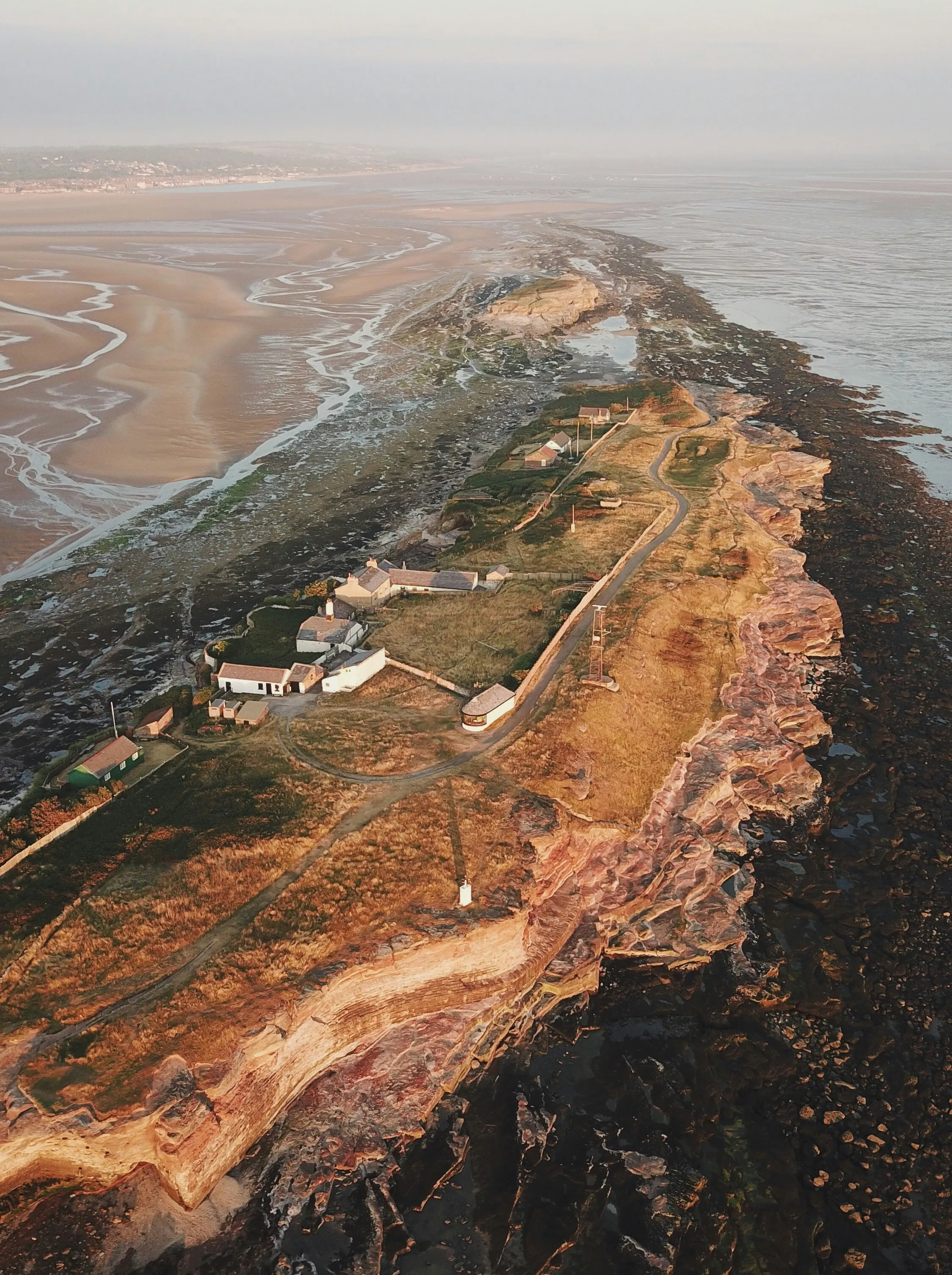
For a small island in the Dee Estuary, Hilbre has a surprisingly rich history. People have been coming here for over a thousand years, drawn by the same things that bring visitors today: its position at the edge of the land, its wildlife, and its wild beauty. The island sits off the coast of West Kirby on the Wirral peninsula, and its story is woven into the history of the whole region.
Where the Name Comes From
The name Hilbre is believed to come from St Hildeburgh (sometimes written as Hildeburga), an Anglo-Saxon saint associated with the area. Little is known about Hildeburgh herself, but she was venerated locally and may have had connections to a religious community on or near the island. The earliest recorded forms of the name include “Hildeburghege” (meaning Hildeburgh’s island) and “Hilbrey,” both of which suggest the island was named after this religious figure rather than a geographical feature.
The nearby town of West Kirby also has old roots: “Kirby” comes from the Old Norse kirkju-byr, meaning “church village,” a reminder that this part of the Wirral has been settled — and fought over — by Saxons, Norse, and Normans for well over a thousand years. The whole Dee Estuary coastline is rich with place names that trace back to these early settlers.
The Monks of Hilbre
In the early medieval period, Benedictine monks from the Abbey of St Werburgh in Chester (now Chester Cathedral) established a small cell or chapel on Hilbre. The island served as a stopping point for pilgrims crossing the Dee Estuary to Basingwerk Abbey in North Wales — a journey that would have been dangerous even then, with the same tidal risks that visitors face today.
The monks maintained a presence on the island for several centuries. A small chapel dedicated to the Virgin Mary stood on the island, and there are records of the monks offering shelter and guidance to travellers making the estuary crossing. Traces of the old buildings survived for a long time, though little remains visible today beyond some foundation stones that are easily missed among the natural rock.
The island’s remoteness and tidal isolation would have made it an ideal place for contemplation and prayer — and honestly, standing on Hilbre on a quiet winter morning with nothing but the sound of the wind and the birds, you can see exactly why they chose it. There’s a stillness to the place that hasn’t changed in a thousand years.
The Telegraph Station
In the early 19th century, Hilbre found a new purpose. A telegraph station was built on the island as part of a semaphore chain that relayed signals about shipping movements to Liverpool. From Hilbre’s vantage point, observers could see ships entering the Dee and relay their arrival ahead to the port.
This was before the electric telegraph, so messages were sent using visual signals — flags, shutters, and mechanical arms — between a chain of hilltop stations stretching from the coast to Liverpool. Hilbre’s elevated position at the mouth of the estuary made it a natural choice for the western end of the chain.
The station was part of the commercial infrastructure that helped Liverpool become one of the world’s great ports. Ships arriving from the Americas, Africa, and beyond would be spotted from Hilbre, and news of their arrival would reach the Liverpool merchants before the ships themselves docked — a vital advantage in an era when information moved no faster than a person could carry it. You can still appreciate why the location was chosen: from the high ground on Hilbre, you have an unobstructed view of the shipping channels and the open sea to the west and north. On a clear day, the vantage point is remarkable.
The Lifeboat Station
Hilbre had a lifeboat station from 1849 until its closure in 1939 — ninety years of service in some of the most treacherous waters on the British coast. The lifeboat house was built on the island to serve the busy shipping lanes of the Dee Estuary and Liverpool Bay, and over its lifetime the station launched many rescues in conditions that are hard to imagine today.
The old lifeboat slipway is still visible on the west side of the island, running down the red sandstone to the water’s edge. When you’re standing there looking out to sea, it’s worth thinking about the crews who launched into those waters on dark, stormy nights. The lifeboat had to be dragged down the slipway and rowed out into the estuary — there were no engines in the early years. You can see the slipway clearly on the walking route around the island.
The station closed in 1939, by which time motorised lifeboats operating from other stations could cover the area more effectively. But for nearly a century, Hilbre’s lifeboat crews were the first line of rescue for ships in distress off the Wirral coast.
The War Years
During the Second World War, Hilbre was used for military observation. Its position at the mouth of the estuary made it useful for watching shipping and looking out for enemy activity in the Irish Sea and Liverpool Bay. The island’s buildings were adapted for military use and a small garrison was maintained throughout the war.
Liverpool was one of the most heavily bombed cities in Britain during the Blitz, and the port was crucial to the Atlantic convoys that kept the country supplied. Hilbre’s role was modest but strategic: an observation post watching the western approaches to one of Britain’s most important ports. Lookouts would have scanned the same waters that the telegraph operators had watched a century earlier, and that the lifeboat crews had launched into for rescue missions.
After the war ended, the military presence was withdrawn and the island’s buildings fell into disrepair. For a time, Hilbre was something of a forgotten place — too remote to develop, too small to farm, and with its strategic purpose spent. But this period of quiet neglect may have been exactly what the island needed. Without human activity, the wildlife began to flourish, and the case for conservation grew stronger each year.
Becoming a Nature Reserve
After the war, Hilbre’s importance for wildlife became increasingly recognised. The island and its surroundings are part of the Dee Estuary Site of Special Scientific Interest (SSSI), one of the most important estuarine habitats in the UK. The estuary supports internationally significant populations of wading birds, and the islands provide vital roosting sites at high tide.
Hilbre became a Local Nature Reserve managed by Wirral Council. The Hilbre Bird Observatory, established in the 1950s, continues to monitor and record bird sightings on the island. Volunteers have built up decades of valuable data on migration patterns and species populations — an unbroken record of observation that is itself a piece of living history.
Hilbre Today
The buildings on the island today are used by the observatory and the ranger service. The island’s story has come full circle in a way: from a place of pilgrimage and prayer, through industry and war, to a sanctuary for wildlife. Different purposes, but the same pull of this extraordinary little island at the edge of the land.
The island has a famous former resident. Crime writer Ann Cleeves, creator of Vera and Shetland, moved to Hilbre in January 1978 when her husband Tim became the islands' custodian, and lived four years in Telegraph House without mains electricity or running water, helping to run the Coastguard radio and collecting driftwood for the fire. Her first published writing was a chapter in Hilbre: The Cheshire Island. She became patron of the Friends of Hilbre in March 2023. The Friends and the Hilbre Community Land Trust, which took a lease on the historic buildings from Wirral Council in 2024, are now restoring the Telegraph Station and the Day Room as a heritage centre.
You can still see the old lifeboat slipway, the foundations from the telegraph era, and the buildings that have served so many different purposes over the centuries. The grey seals haul out on the same rocks where monks once watched for pilgrims, and the wading birds that fill the estuary each winter have been doing so since long before any of us were here. The sandstone itself is 250 million years old — human history is just the most recent layer.
Check today’s crossing times and go and see it for yourself. The walk from West Kirby hasn’t changed much since the pilgrims made the same journey a thousand years ago.
Written by the HilbreTides team. We walk to Hilbre regularly throughout the year and update our guides based on what we see on the ground. Last updated April 2026.