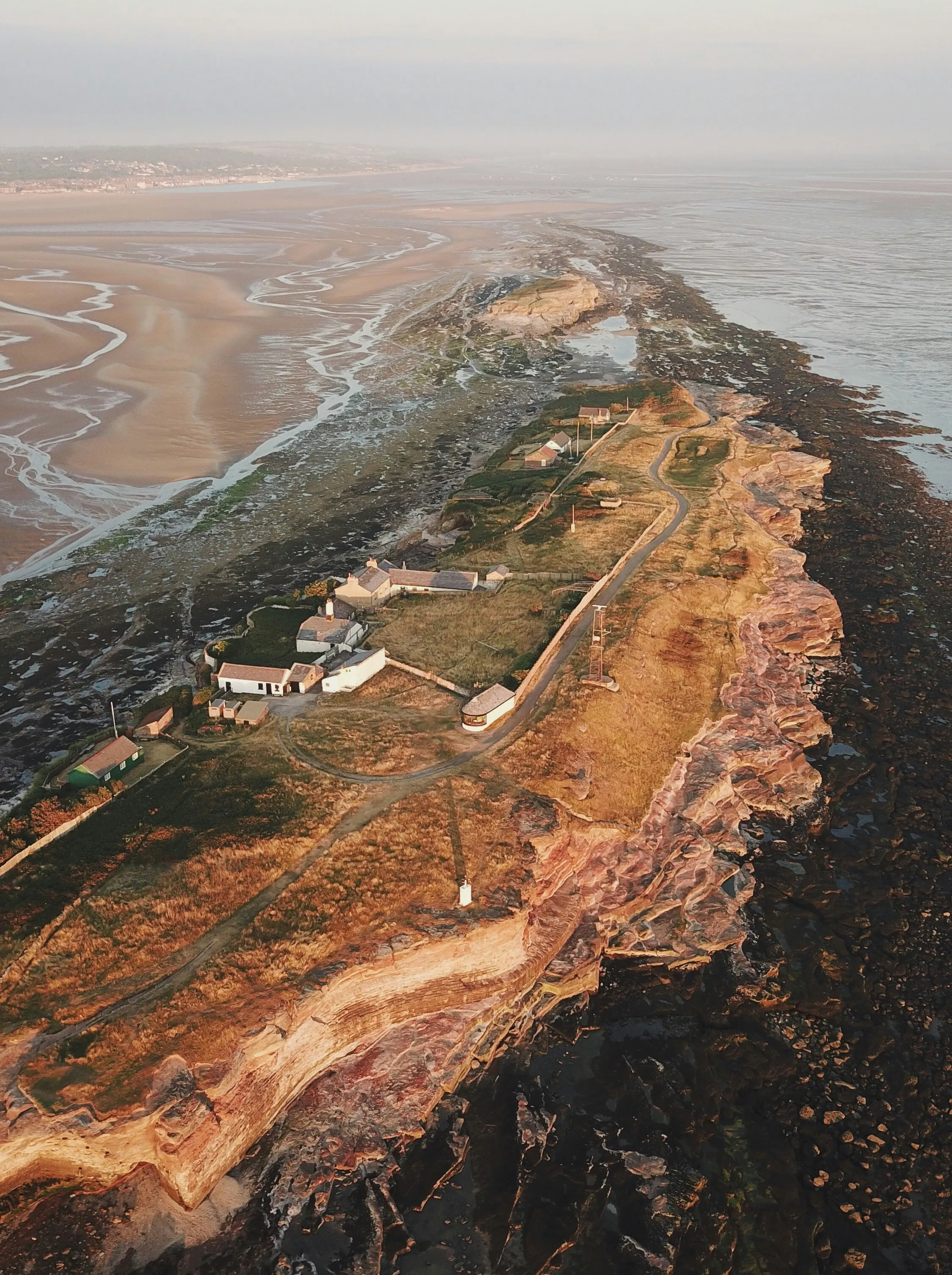
When people talk about “Hilbre Island,” they usually mean the largest of a group of three tidal islands that stretch out into the Dee Estuary from West Kirby on the Wirral. But each island has its own personality, and the walking route takes you across all three. Here’s what to know about each one.
Little Eye
Little Eye is the first island you come to, about a mile from the West Kirby shoreline. It’s the smallest of the three — really just a low rocky outcrop that rises a few metres above the sand. Most people pass straight over it on their way to Hilbre, but it’s worth pausing here for a few minutes.
The rocks on Little Eye are the same ancient red sandstone you’ll see across all three islands — 250-million-year-old Triassic rock that was laid down in desert conditions long before the Dee Estuary existed. At low tide, the rock platforms around Little Eye are exposed and you can see the layering and erosion patterns clearly.
At high tide, Little Eye is one of the first places to get cut off, which is why the channel between here and the mainland is the one you need to be most careful about timing. The water can come in surprisingly quickly across the flat sand, and this channel fills before the others.
It’s also a good spot for wading birds: at high tide, oystercatchers, turnstones, and other waders roost on the rocks here as the mudflats flood. We’ve counted over a dozen species from this one spot on a good winter morning. If you’re interested in birdwatching, it’s worth arriving early and spending 15 minutes here with binoculars before moving on.
Middle Eye
Middle Eye is the second island along the route. It’s larger than Little Eye but smaller than Hilbre itself — a stepping stone between the two. The terrain is rockier and more uneven than Little Eye, with some good examples of the red sandstone that characterises all three islands.
The most notable feature of Middle Eye is its position. From here, you get your first really good view of Hilbre Island ahead of you, and if you turn around, West Kirby and the Wirral shoreline look surprisingly far away. It’s at this point that most first-time visitors realise just how far out into the Dee Estuary they’ve walked — and why getting the tide times right matters so much.
The crossing between Middle Eye and Hilbre involves negotiating a channel called “the gutter” which can hold water even at low tide. Depending on the state of the tide, you may need to pick your way across some wet sand and shallow water here. It’s rarely more than ankle deep if you’ve timed it right, but waterproof boots are worth wearing. Keep to the established crossing route and you’ll be fine — our walking route guide has the details.
Getting onto and off Middle Eye is best done on the footpath that runs up and over the island. It’s tempting to skirt round the edge, but those rocks are very slippery, and the path over the top is the safer line in both directions.
Middle Eye also has some interesting rock pools on its seaward side, though they’re smaller than the ones on Hilbre. If you have time, they’re worth a quick look on the way through — but take care on the way down to them, and keep an eye on the tide.
Hilbre Island
The main island and the destination for most walkers. Hilbre is roughly 500 metres long, covers about 4.5 hectares (around 11 acres), and is the highest of the three islands. It’s the only one with buildings — several are used by the Hilbre Bird Observatory and the ranger service, and you can still see the remains of the old lifeboat slipway on the west side, a remnant of the island’s long history.
This is where you’ll find the most wildlife and the most space to explore. The grey seal colony tends to be visible from the north end, where they haul out on the rocks and sandbanks below. On a good day you might see 20 or 30 seals sprawled out on the rocks, and curious heads often pop up in the water around the shoreline.
The western side of Hilbre faces out towards Wales across the Dee Estuary and catches the evening light beautifully — it’s a spectacular spot for sunsets. The rock pools here are the best of the three islands, particularly on the south-west corner where the sandstone terraces create sheltered pools that fill with crabs, anemones, and small fish at low tide.
The highest point on Hilbre gives you panoramic views in every direction: the Welsh hills to the west, Liverpool and the Mersey to the east, the Wirral coastline to the south, and the open Irish Sea to the north. On a clear day, you can see the wind farms out in Liverpool Bay and sometimes the mountains of Snowdonia.
How They Connect
The three islands form a chain running roughly north-west from West Kirby. They’re all part of the same sandstone ridge that once extended further across the Dee Estuary. Erosion over thousands of years has separated them into distinct islands, with channels of sand and water in between.
At low tide, you can walk the entire chain in sequence: across the sand to Little Eye, then to Middle Eye, then to Hilbre. The total distance from the West Kirby shore to Hilbre is about two miles, and the walk takes roughly 45 minutes to an hour depending on conditions and how often you stop.
All three islands are part of the Dee Estuary Site of Special Scientific Interest and Local Nature Reserve, managed by Wirral Council. The whole area is ecologically important for wading birds, seals, and the intertidal habitats between the islands.
Can You Explore All Three?
Yes, and most people do since the walking route passes over all three. Little Eye and Middle Eye are relatively quick to cross, so most of your time will be spent on Hilbre itself. But do stop and look around on each one — they each offer different perspectives across the estuary, and the rock formations vary between them.
A typical visit might look like this: 10 minutes on Little Eye watching the waders, 5 minutes crossing Middle Eye and checking the rock pools, then an hour or more on Hilbre exploring the seal viewing areas, the rock pools, and the old buildings. The whole trip, including the walk from West Kirby and back, usually takes 3 to 4 hours.
Just remember: the same tidal rules apply to all three islands. Once the tide comes in, all of them are cut off. The channels between the islands fill at different rates, so even if Hilbre itself still looks accessible, the route back through Middle Eye and Little Eye may already be flooded.
Wildlife Across the Three Islands
Each island supports slightly different wildlife. Little Eye is primarily a roosting site for wading birds — at high tide the rocks can be packed with oystercatchers, turnstones, and purple sandpipers. Middle Eye has good rock pools on its seaward side, though they’re smaller than those on Hilbre. And Hilbre itself is where the grey seals are most visible, hauled out on the north-facing rocks.
The channels between the islands are interesting too. At low tide, the exposed sand and mud between the islands supports lugworms, cockles, and other invertebrates that attract feeding birds. As the tide comes in, you can sometimes see seals swimming through the channels, and in winter the rising water pushes huge flocks of knot and dunlin off the mudflats and onto the island rocks in spectacular formations.
All three islands are part of the Dee Estuary SSSI, which is designated for its internationally important populations of wintering waders and wildfowl. The Hilbre Bird Observatory has been recording sightings here since the 1950s, building up one of the longest continuous bird monitoring datasets in the region.
Timing Your Visit
Plan your time so you can enjoy each island without having to rush the return crossing. Check today’s safe crossing times before you set out, and read our safety guide if it’s your first visit. As a rule of thumb, set off no later than three hours after high water, and aim to be back on the mainland at least an hour before the crossing window closes.
If you’re bringing children or dogs, our families guide has specific advice. And if you’re not sure what to pack, the what to bring list covers everything you’ll need for a comfortable visit to all three islands.
Written by the HilbreTides team. We walk to Hilbre regularly throughout the year and update our guides based on what we see on the ground. Last updated April 2026.